
Can Your Condo Board Ban Your Dog? Start With the Documents
A board vote is only the beginning of the legal question. This week's Condo Craze & HOAs explores pet restrictions, assistance animals, costly paperwork delays and what to do when a violation notice arrives.
Condo Craze & HOAs • October 18, 2026 • Season 4, Episode 30

Your dog is waiting for a walk. Your condo board is waiting for you to get rid of him.
That is the predicament in the fictional opening of this week's Condo Craze & HOAs. A tenant receives a notice announcing a new pet ban. The board voted. The restriction is in writing. There is a deadline.
Then the resident opens the condominium declaration. It allows pets, subject to restrictions, and says nothing about banning them for renters.
Which document controls?
Eric Glazer and Karen Curtis used that conflict to explore a question that quickly becomes personal: when an association tells you an animal cannot stay, does it have the authority to make that demand? The answer begins with the governing documents. A disability-related accommodation can add another layer.
Watch the full October 18 episode, or start with the pet-ban discussion at 6:28.
A board vote cannot rewrite the declaration
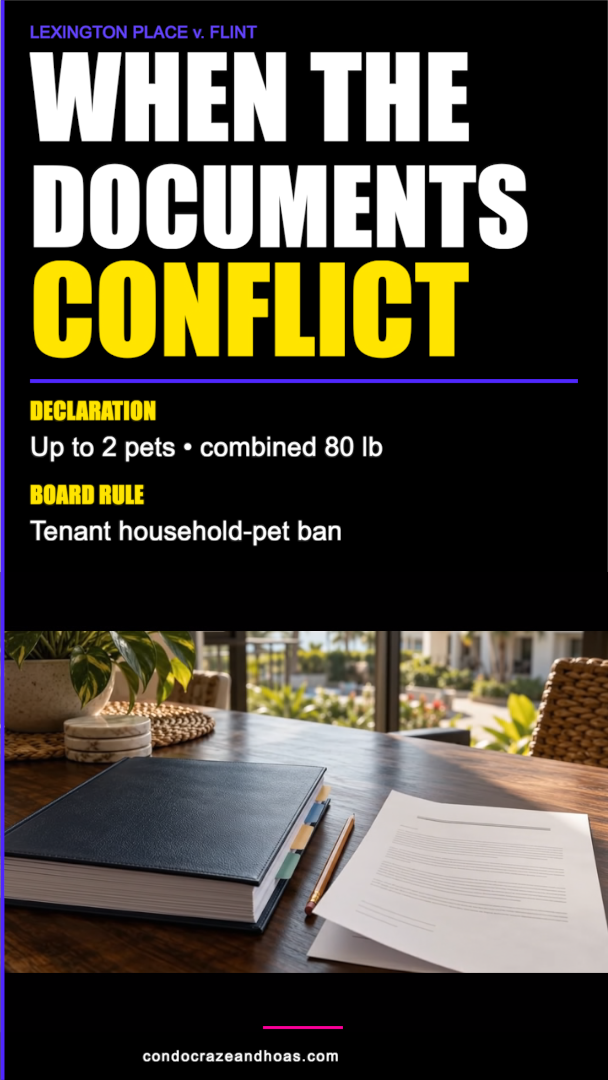
In Lexington Place Condominium Association v. Flint, the declaration permitted up to two household pets per unit, with a combined 80-pound limit. It did not distinguish between owners and tenants.
The board nevertheless adopted a rule prohibiting tenants and other occupants from keeping pets. Existing animals could remain, but could not be replaced. The board also removed a dog park and a wallyball court without the owner approval required by the declaration.
Michelle and Kevin Flint challenged those actions. They prevailed in arbitration, then in circuit court. On June 24, 2022, Florida's Fifth District Court of Appeal affirmed the judgment requiring restoration of the amenities and withdrawal of the pet rule. The court also granted appellate attorney's fees, with the amount left for the trial court to determine. Read the court's opinion.
The problem was authority. Directors had attempted to change rights in the declaration without following its amendment requirements. Grandfathering existing animals did not cure that defect.
For residents and boards, the useful first question is the same: where does this restriction come from, and how was it adopted?
A leash rule and a pet ban are different decisions

A rule requiring leashes on common property regulates how an allowed animal uses shared space. A rule prohibiting the animal altogether changes something much more fundamental.
That distinction shaped Eric's discussion at 9:18. Some declarations grant broad authority over animals. Others contain their own restrictions. One community's answer cannot simply be copied into another's rulebook.
A viewer later asked what happens when the documents say nothing about pets. At 30:11, Eric explained why the board's delegated rulemaking powers still matter, including whether they concern only common areas or also use of the units. Silence is a reason to examine the documents more carefully.
The dog park adds a related lesson. Florida's material-alteration statute looks first to the declaration's approval procedure. If it specifies none, the statutory default generally requires approval by 75 percent of the association's total voting interests. It is too broad to assume every material alteration always requires an owner vote regardless of the declaration. See section 718.113(2)(a).
Lexington Place was a condominium case. HOA owners and directors should examine their own covenants and the applicable provisions of Chapter 720.
An assistance animal raises a different question

Even a valid pet restriction may require an exception for a qualifying disability-related need.
The Fair Housing Act requires reasonable accommodations in rules and policies when necessary to give a person with a disability an equal opportunity to use and enjoy a home. That is why proving a pet rule is valid does not finish the analysis of an accommodation request. Read 42 U.S.C. § 3604(f)(3)(B).
As Eric explained at 11:41, assistance animals are not ordinary pets. A service animal performs trained tasks; an emotional support animal need not have that training. But affection for an animal, by itself, does not establish an entitlement to an accommodation.
Owners should explain what accommodation they are requesting. Boards should evaluate the request on its facts, with appropriate legal guidance, rather than treating a no-pet clause as the complete answer.
When more paperwork becomes a costly denial

In Bhogaita v. Altamonte Heights Condominium Association, a veteran with PTSD had an emotional support dog that exceeded the community's 25-pound limit. His treating psychiatrist provided letters explaining the disability-related need.
The association continued seeking information beyond what was necessary. The Eleventh Circuit concluded that its prolonged response amounted to a constructive denial of the accommodation. In 2014, the court affirmed the judgment and an award of $127,512 in attorney's fees; the jury had awarded $5,000 in compensatory damages. Read the Eleventh Circuit opinion.
The lesson from 18:10 is practical: a review process needs to reach a decision. Repeated requests are not automatically reasonable simply because the board has not written the word “denied.”
What can the association ask for?
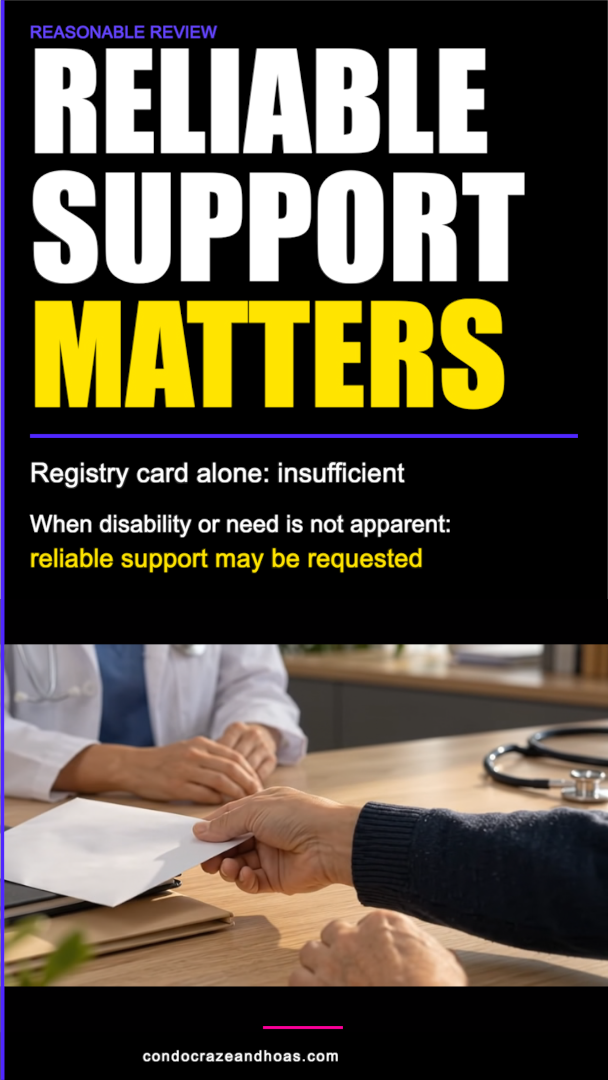
Florida's ESA statute draws important boundaries. When the disability or disability-related need is not apparent, a housing provider may request reliable supporting information. It may not require disclosure of the diagnosis, disability severity or disability-related medical records. An internet registration, certificate, card or patch alone is insufficient. For multiple ESAs, it may request information about the specific need for each animal. See section 760.27.
That distinction returned throughout the live calls. At 37:48, Eric addressed what boards can ask. At 52:49, a South Beach association president described uncertainty about online paperwork.
The practical middle ground is meaningful, prompt review: identify what is genuinely missing, explain it clearly and allow the resident to respond. Once adequate support is provided, do not keep moving the goalposts.
Safety concerns require evidence

An accommodation does not make safety irrelevant. Florida law permits denial of an ESA request when the animal presents a direct threat to others' health or safety, or to others' property, that another reasonable accommodation cannot reduce or eliminate. Section 760.27(2)(a).
The discussion at 21:57 is a reminder to document actual conduct. Dates, incident reports and specific descriptions are more useful than labels or assumptions.
A barking complaint deserves attention, too, but it should not automatically be treated as proof that the direct-threat standard has been met. Boards should obtain advice on the appropriate response and process before demanding removal.
Five steps when a notice arrives

Eric's checklist at 22:46 gives residents a useful starting point:
Get the current documents. Gather the declaration, recorded amendments and rules. Renters should involve their unit owner; a landlord's permission does not by itself resolve an association restriction.
Ask for the authority. Request the specific provision and adoption procedure supporting the demand. Keep the notice and calendar every response or hearing deadline.
Identify the right argument. A challenge to an unauthorized rule and a disability-accommodation request are different issues. Make clear which applies, or whether both do.
Preserve the record. Save approvals, emails, notices and incident reports. A neighbor's dog may be relevant to enforcement history, but it does not guarantee a defense.
Use the correct process. Arbitration, presuit mediation and fair-housing claims follow different routes. Get timely advice rather than assuming an email stops enforcement.
Keep addressing ordinary responsibilities while the dispute is reviewed: leash the dog, clean up and respond to credible conduct complaints.
The live calls went beyond pets
The second half also examined condo term limits and older governing documents, board enforcement discretion, and a neighbor's options when restrictions go unenforced. Those questions require their own document-specific analysis.
An HOA caller also asked about speaking on agenda items. Florida law gives members that right at board meetings, even when their bylaws are silent. Watch at 1:01:44 and read section 720.303(2)(b).
Across these conversations, the same habit pays off: read the documents, check the law and respond before a disagreement becomes a much bigger problem.
Watch Condo Craze & HOAs live Sundays at 11 a.m. Eastern. Bring your questions to the YouTube chat or call 717-GLAZER8 (717-452-9378).
This article provides general information, not legal advice. The governing documents, applicable law and facts of a particular dispute matter. Images are illustrative and do not depict the actual people or events in the cited cases.