
HOW TO HANDLE AN HOA DISPUTE
Many HOA owners and board members make the same expensive mistake, they run straight to court. In Florida, that’s often legally wrong. Under Florida Statute 720.311, most HOA disputes must go through alternative dispute resolution before a lawsuit can begin. Skip that step and your case could be delayed, dismissed, or cost far more than necessary. Knowing whether your dispute requires mediation, arbitration, or can go straight to court can save thousands in legal fees.

By Eric M. Glazer
· 2 min read
Too many HOA owners and board members make the same costly mistake—they run straight to court. In Florida, that’s often not just premature, it’s legally wrong.
The Legislature has made it clear: most disputes in homeowners’ associations must go through alternative dispute resolution (ADR) before a lawsuit is filed. If you skip this step, your case can be delayed, dismissed, or become far more expensive than it needs to be. In fact, here is how the statute starts:
720.311 Dispute resolution.— (1) The Legislature finds that alternative dispute resolution has made progress in reducing court dockets and trials and in offering a more efficient, cost-effective option to litigation.
As you know, HB 657 just tried to do away with mandatory pre-suit mediation. The funny thing is, this sentence was to remain in the statute. Where is the logic?
Here’s how the statute actually works.
Step One: Know Which Process Applies!
Not all HOA disputes are treated the same. Florida HOA law divides them into two categories: arbitration and presuit mediation.
Election and Recall Disputes: No Mediation Allowed
If your dispute involves:
Board elections, or
The recall of board members
You do not get to mediate first.
These disputes must be:
Filed for binding arbitration with the DBPR, or
Filed directly in court
And make no mistake—arbitration has teeth:
There is a filing fee (at least $200 to start)
The losing party pays attorney’s fees and costs
Most Other Disputes: Mediation Comes First
For the majority of HOA conflicts, the law requires presuit mediation before you can file a lawsuit.
This includes disputes over:
Use of property or common areas
Covenant enforcement
Amendments to governing documents
Board or committee meetings
Membership meetings (excluding elections)
Access to official records
Mediation is not optional—it is a legal prerequisite.
It is also:
Confidential
Privileged (meaning what’s said can’t be used later in court)
What You Can Still Take Straight to Court
Not everything requires mediation.
You can bypass it for:
Collection of assessments or fines
Other monetary disputes
Enforcement of prior mediation agreements
In those cases, litigation can begin immediately.
A Critical Detail Most People Miss
When you file for arbitration or serve a demand for mediation, the statute of limitations is paused.
That can be the difference between preserving your claim—or losing it entirely.
The Bottom Line
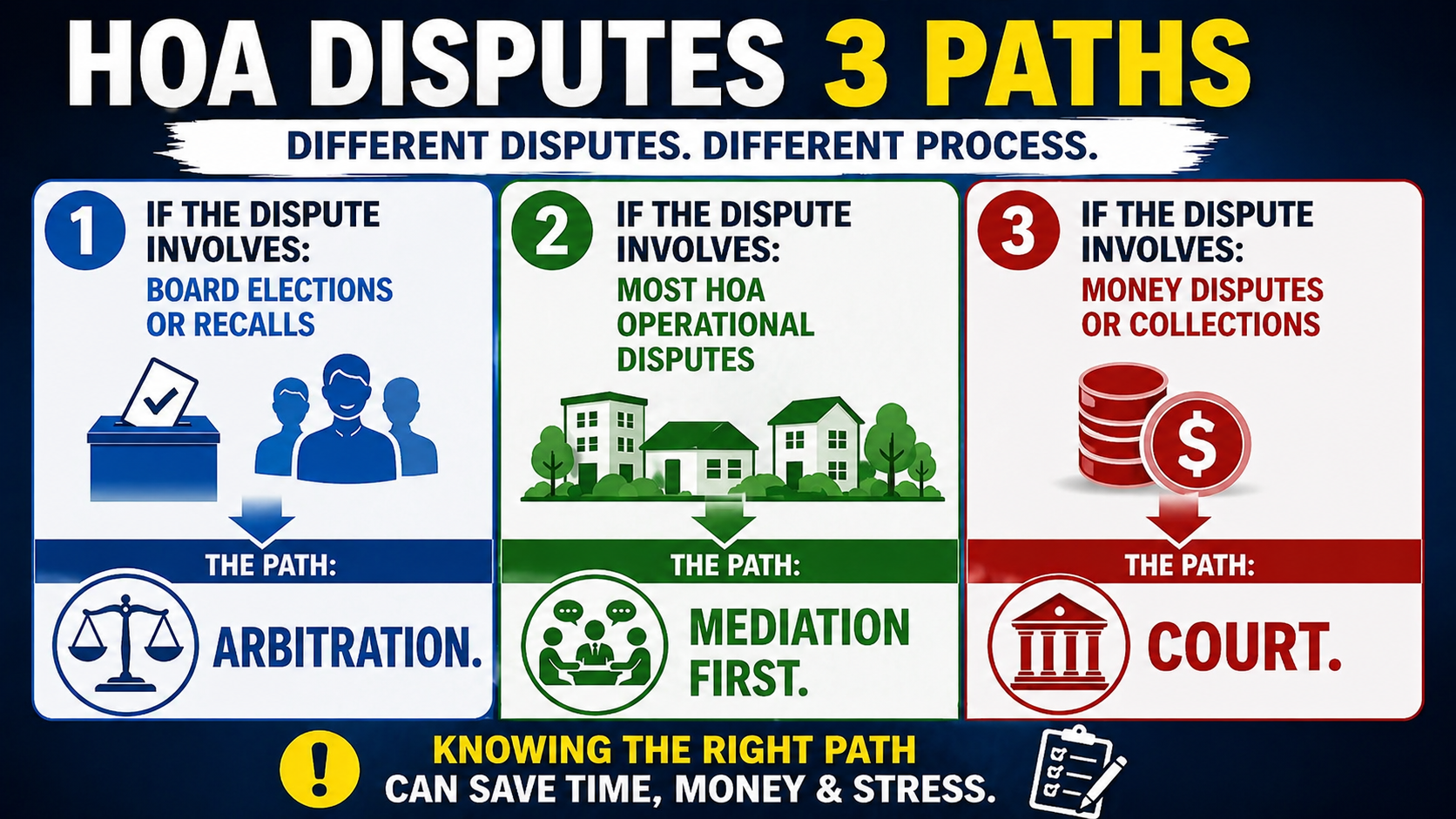
Election and recall disputes → arbitration (not mediation)
Most operational disputes → mediation first
Collection and money claims → straight to court
Ignore these rules, and you risk wasting time, money, and leverage before your case even begins.
Practical Advice For HOA Disputes
Before taking action, ask one simple question:
“Am I required to mediate or arbitrate first?”
If you get that wrong, everything that follows can unravel quickly.
And in this area of the law, it often does.